to what species does the term hominin refer?
| Hominini Temporal range: | |
|---|---|
 | |
| Ii hominins: A man (Homo sapiens) holding a chimpanzee (Pan troglodytes) | |
Scientific classification  | |
| Kingdom: | Animalia |
| Phylum: | Chordata |
| Form: | Mammalia |
| Guild: | Primates |
| Suborder: | Haplorhini |
| Infraorder: | Simiiformes |
| Family: | Hominidae |
| Subfamily: | Homininae |
| Tribe: | Hominini Arambourg, 1948 |
| Type species | |
| Homo sapiens Linnaeus, 1758 | |
| Genera | |
| |
The Hominini course a taxonomic tribe of the subfamily Homininae ("hominines"). Hominini includes the extant genera Man (humans) and Pan (chimpanzees and bonobos) and in standard usage excludes the genus Gorilla (gorillas).
The term was originally introduced by Camille Arambourg (1948). Arambourg combined the categories of Hominina and Simiina due to Gray (1825) into his new subtribe.
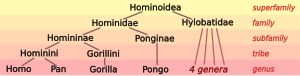
The taxonomic nomenclature of hominoids
Traditionally, chimpanzees, gorillas and orangutans were grouped together as pongids. Since Gray'south nomenclature, evidence has accumulated from genetic phylogeny confirming that humans, chimpanzees, and gorillas are more closely related to each other than to the orangutan.[2] The former pongids were reassigned to the subfamily Hominidae ("great apes"), which already included humans,[ii] but the details of this reassignment remain contested; within Hominini, not every source excludes gorillas, and not every source includes chimpanzees.
Humans are the only extant species in the Australopithecine branch (subtribe), which also contains many extinct shut relatives of humans.
Terminology and definition [edit]
Concerning membership, when Hominini is taken to exclude Pan, Panini ("panins")[3] may refer to the tribe containing Pan equally its merely genus.[4] [five] Or peradventure place Pan with other dryopithecine genera, making the whole tribe or subtribe of Panini or Panina together. Minority dissenting nomenclatures include Gorilla in Hominini and Pan in Homo (Goodman et al. 1998), or both Pan and Gorilla in Human being (Watson et al. 2001).
By convention, the adjectival term "hominin" (or nominalized "hominins") refers to the tribe Hominini, whereas the members of the subtribe Hominina (and thus all primitive human species) are referred to every bit "homininan" ("homininans").[six] This follows the proposal by Mann and Weiss (1996), which presents tribe Hominini as including both Pan and Human being, placed in split subtribes. The genus Pan is referred to subtribe Panina, and genus Human is included in the subtribe Hominina (see higher up).[7] However, there is an alternative convention which uses "hominin" to exclude members of Panina, i.e. either merely for Homo or for both human and australopithecine species. This alternative convention is referenced in due east.1000. Coyne (2009)[eight] and in Dunbar (2014).[five] Potts (2010) in addition uses the name Hominini in a different sense, every bit excluding Pan, and uses "hominins" for this, while a split up tribe (rather than subtribe) for chimpanzees is introduced, under the name Panini.[4] In this recent convention, contra Arambourg, the term "hominin" is practical to Homo, Australopithecus, Ardipithecus, and others that arose after the split from the line that led to chimpanzees (see cladogram below);[9] [10] that is, they distinguish fossil members on the man side of the split, equally "hominins", from those on the chimpanzee side, as "not hominins" (or "non-hominin hominids").[8]
Cladogram [edit]
This cladogram shows the clade of superfamily Hominoidea and its descendent clades, focussed on the division of Hominini (omitting particular on clades non ancestral to Hominini). The family Hominidae ("hominids") comprises the tribes Ponginae (including orangutans), Gorillini (including gorillas) and Hominini, the latter ii forming the subfamily of Homininae. Hominini is divided into Panina (chimpanzees) and Australopithecina (australopithecines). The Hominina (humans) are ordinarily held to accept emerged within the Australopithecina (which would roughly stand for to the alternative definition of Hominini according to the alternative definition which excludes Pan).
Genetic assay combined with fossil prove indicates that hominoids diverged from the Old Globe monkeys about 25 million years agone (Mya), near the Oligocene-Miocene purlieus.[eleven] The most recent common ancestors (MRCA) of the subfamilies Homininae and Ponginae lived about 15 million years ago. The most well-known fossil genus of Ponginae is Sivapithecus, consisting of several species from 12.5 million to eight.five million years ago. It differs from orangutans in dentition and postcranial morphology.[12] In the following cladogram, the approximate time the clades radiated newer clades is indicated in millions of years ago (Mya).
Evolutionary history [edit]

Model of the phylogeny of Hominini over the past ten 1000000 years.
Both Sahelanthropus and Orrorin existed during the estimated duration of the bequeathed chimpanzee-human being speciation events, within the range of eight to 4 million years ago (Mya). Very few fossil specimens have been found that can be considered directly ancestral to genus Pan. News of the first fossil chimpanzee, plant in Kenya, was published in 2005. Still, it is dated to very recent times—between 545 and 284 thousand years agone.[13] The departure of a "proto-homo" or "pre-human" lineage separate from Pan appears to have been a process of complex speciation-hybridization rather than a make clean split, taking place over the flow of anywhere between thirteen Mya (close to the age of the tribe Hominini itself) and some 4 Mya. Unlike chromosomes appear to take separate at different times, with broad-scale hybridization activity occurring between the two emerging lineages as belatedly as the period 6.3 to five.4 Mya, according to Patterson et al. (2006),[xiv] This research grouping noted that one hypothetical late hybridization period was based in particular on the similarity of Ten chromosomes in the proto-humans and stem chimpanzees, suggesting that the final departure was even as recent as 4 Mya. Wakeley (2008) rejected these hypotheses; he suggested alternative explanations, including selection pressure on the X chromosome in the bequeathed populations prior to the chimpanzee–human being last common antecedent (CHLCA).[15]
Most Dna studies observe that humans and Pan are 99% identical,[xvi] [17] but one study found only 94% commonality, with some of the divergence occurring in noncoding DNA.[xviii] It is nigh likely that the australopithecines, dating from 4.four to 3 Mya, evolved into the earliest members of genus Homo.[xix] [20] In the twelvemonth 2000, the discovery of Orrorin tugenensis, dated as early as six.ii Mya, briefly challenged critical elements of that hypothesis,[21] as information technology suggested that Human did not in fact derive from australopithecine ancestors.[22] All the listed fossil genera are evaluated for:
- probability of being bequeathed to Homo, and
- whether they are more than closely related to Man than to any other living primate—two traits that could identify them as hominins.
Some, including Paranthropus, Ardipithecus, and Australopithecus, are broadly thought to exist bequeathed and closely related to Homo;[23] others, especially before genera, including Sahelanthropus (and perhaps Orrorin), are supported by one community of scientists just doubted past another.[24] [25]
List of known hominin species [edit]
- Sahelanthropus tchadensis
- Orrorin tugenensis
- Ardipithecus kadabba
- Ardipithecus ramidus
- Australopithecus anamensis
- Australopithecus afarensis
- Australopithecus deyiremeda
- Australopithecus garhi
- Kenyanthropus platyops
- Australopithecus africanus
- Australopithecus sediba
- Paranthropus aethiopicus
- Paranthropus boisei
- Paranthropus robustus
- Pan troglodytes
- Pan paniscus
- Homo habilis
- Man rudolfensis
- Homo ergaster
- Human being erectus
- Man antecessor
- Homo heidelbergensis
- Homo naledi
- Homo neanderthalensis
- Human being denisova
- Homo sapiens
- Homo floresiensis
- Homo luzonensis
Run into also [edit]
- History of hominoid taxonomy
- Human evolution
- Human taxonomy
- Human being timeline
- List of human evolution fossils
References [edit]
- ^ Fuss, J.; Spassov, N.; Begun, D. R.; Böhme, M. (2017). "Potential hominin affinities of Graecopithecus from the Belatedly Miocene of Europe". PLOS 1. 12 (5): e0177127. Bibcode:2017PLoSO..1277127F. doi:10.1371/journal.pone.0177127. PMC5439669. PMID 28531170.
- ^ a b McNulty, Kieran P. (2016). "Hominin taxonomy and phylogeny: what's in a proper name?". Nature. Retrieved 10 August 2021.
All the same, overwhelming genetic bear witness has since demonstrated that humans, chimpanzees, and gorillas are much more closely related to each other than to the orangutan ... Thus, in that location is no genetic back up for grouping the great apes together in a singled-out group from humans. For this reason, many researchers now place all species of great ape and human being within a single family, Hominidae – making them all proper "hominids".
- ^ Delson (1977). "Catarrhine phylogeny and nomenclature: principles, methods and comments". Journal of Human Evolution. 6 (5): 450. doi:10.1016/S0047-2484(77)80057-2.
- ^ a b Potts (2010). What does it mean to exist human?. Washington: National Geographic Society. p. 34. ISBN978-1-4262-0606-1.
- ^ a b Dunbar, Robin (2014). Human development. ISBN9780141975313.
Conventionally, taxonomists now refer to the bully ape family (including humans) as 'hominids', while all members of the lineage leading to modern humans that arose after the split with the [Human-Pan] LCA are referred to as 'hominins'. The older literature used the terms hominoids and hominids respectively.
- ^ Bernard Woods (11 May 2010). "Reconstructing man evolution: Achievements, challenges, and opportunities". Proceedings of the National University of Sciences of the U.s. of America. 107 (Supplement 2): 8902–8909. Bibcode:2010PNAS..107.8902W. doi:10.1073/PNAS.1001649107. ISSN 0027-8424. PMC3024019. PMID 20445105. Wikidata Q28743412.
- ^ Mann, Alan; Weiss, Mark (1996). "Hominoid phylogeny and taxonomy: a consideration of the molecular and fossil testify in an historical perspective". Molecular Phylogenetics and Evolution. 5 (1): 169–181. doi:ten.1006/mpev.1996.0011. PMID 8673284.
- ^ a b Coyne, Jerry A. (2009). Why development is true. London: Penguin Books. pp. 197–208, 244, 248. ISBN978-0-670-02053-ix.
Anthropologists apply the term hominin to all the species on the "human" side of our family unit tree later information technology separate from the co-operative that became modernistic chimps." (p.197)
- ^ Brenda J. Bradley (i April 2008). "Reconstructing phylogenies and phenotypes: a molecular view of human evolution". Periodical of Anatomy. 212 (4): 337–353. doi:10.1111/J.1469-7580.2007.00840.X. ISSN 1469-7580. PMC2409108. PMID 18380860. Wikidata Q24646554.
- ^ Wood; Richmond, B. Grand. (2000). "Human evolution: taxonomy and paleobiology". Journal of Anatomy. 197 (Pt i): 19–threescore. doi:x.1046/j.1469-7580.2000.19710019.10. PMC1468107. PMID 10999270.
Thus human development is the report of the lineage, or clade, comprising species more closely related to modern humans than to chimpanzees. Its stalk species is the then-chosen 'common hominin ancestor', and its only extant member is Human being sapiens. This clade contains all the species more closely related to modernistic humans than to whatsoever other living primate. Until recently, these species were all subsumed into a family, Hominidae, but this group is now more usually recognised as a tribe, the Hominini.
- ^ "Fossils may pinpoint critical split between apes and monkeys". redOrbit.com. 15 May 2013.
- ^ Taylor, C. (2011). "Onetime men of the woods". Palaeos. Retrieved 4 Apr 2013.
- ^ McBrearty, Sally; Jablonski, Nina Grand. (2005). "Offset fossil chimpanzee". Nature. 437 (7055): 105–108. Bibcode:2005Natur.437..105M. doi:ten.1038/nature04008. PMID 16136135. S2CID 4423286.
- ^ Patterson, N.; Richter, D. J.; Gnerre, S.; Lander, E. Southward.; Reich, D. (June 2006). "Genetic evidence for circuitous speciation of humans and chimpanzees". Nature. 441 (7097): 1103–8. Bibcode:2006Natur.441.1103P. doi:x.1038/nature04789. PMID 16710306. S2CID 2325560.
- ^ Wakeley, J. (March 2008). "Complex speciation of humans and chimpanzees". Nature. 452 (7184): E3–iv, discussion E4. Bibcode:2008Natur.452....3W. doi:10.1038/nature06805. PMID 18337768. S2CID 4367089.
Patterson et al. suggest that the apparently curt divergence time between humans and chimpanzees on the 10 chromosome is explained past a massive interspecific hybridization result in the ancestry of these two species. All the same, Patterson et al. exercise not statistically examination their own null model of simple speciation earlier terminal that speciation was complex, and—even if the nil model could be rejected—they practice not consider other explanations of a short departure time on the X chromosome. These include natural selection on the X chromosome in the common ancestor of humans and chimpanzees, changes in the ratio of male-to-female mutation rates over time, and less extreme versions of difference with gene flow. I therefore believe that their claim of hybridization is unwarranted.
- ^ King, Mary-Claire (1973). Protein polymorphisms in chimpanzee and human evolution (Doctoral dissertation). Academy of California, Berkeley.
- ^ Wong, Kate (1 September 2014). "Tiny genetic differences betwixt humans and other primates pervade the genome". Scientific American.
- ^ Minkel, J. R. (xix December 2006). "Humans and chimps: close but non that close". Scientific American.
- ^ Coyne, Jerry A. (2009). Why evolution is true. London: Penguin Books. pp. 202–204. ISBN978-0-670-02053-nine.
After A. afarensis, the fossil record shows a confusing melange of gracile australopithecine species lasting up to about two million years ago. … [T]he late australopithecines, already bipedal, were beginning to show changes in teeth, skull, and brain that presage modern humans. It is very probable that the lineage that gave ascension to modernistic humans included at least i of these species.
- ^ Cameron, D. W. (2003). "Early on hominin speciation at the Plio/Pleistocene transition". Homo: Journal of Comparative Human being Biology. 54 (ane): 1–28. doi:x.1078/0018-442x-00057. PMID 12968420.
- ^ Potts (2010). What does information technology mean to be human?. Washington: National Geographic Social club. p. 38–39. ISBN978-1-4262-0606-1.
- ^ Reynolds, Sally C.; Gallagher, Andrew (2012). African genesis: perspectives on hominin evolution. ISBN9781107019959.
The discovery of Orrorin has ... radically modified interpretations of human origins and the environmental context in which the African apes/hominoid transition occurred, although ... the less likely hypothesis of derivation of Homo from the australopithecines still holds primacy in the minds of most palaeoanthropologists.
- ^ Potts (2010). What does it mean to be human?. Washington: National Geographic Guild. p. 31–424. ISBN978-1-4262-0606-one.
- ^ Brunet, M.; Guy, F.; Pilbeam, D.; et al. (July 2002). "A new hominid from the Upper Miocene of Chad, Fundamental Africa". Nature. 418 (6894): 145–151. Bibcode:2002Natur.418..145B. doi:10.1038/nature00879. PMID 12110880. S2CID 1316969.
Sahelanthropus is the oldest and about primitive known member of the hominid clade, shut to the deviation of hominids and chimpanzees.
- ^ Wolpoff, Milford; Senut, Brigitte; Pickford, Martin; Hawks, John (October 2002). "Sahelanthropus or 'Sahelpithecus'?" (PDF). Nature. 419 (6907): 581–582. Bibcode:2002Natur.419..581W. doi:10.1038/419581a. hdl:2027.42/62951. PMID 12374970. S2CID 205029762.
Sahelanthropus tchadensis is an enigmatic new Miocene species, whose characteristics are a mix of those of apes and Homo erectus and which has been proclaimed by Brunet et al. to be the earliest hominid. However, we believe that features of the dentition, face and cranial base that are said to define unique links between this Toumaï specimen and the hominid clade are either not diagnostic or are consequences of biomechanical adaptations. To stand for a valid clade, hominids must share unique defining features, and Sahelanthropus does not appear to have been an obligate biped.
External links [edit]
- Human Timeline (Interactive) – Smithsonian, National Museum of Natural History (Baronial 2016).
Source: https://en.wikipedia.org/wiki/Hominini
0 Response to "to what species does the term hominin refer?"
Post a Comment