Who Owns the Rights to Work Created on Deep Art?

Artificial intelligence and copyright
October 2017
Past Andres Guadamuz, Senior Lecturer in Intellectual Property Law, University of Sussex, United Kingdom
The rising of the machines is here, but they do not come as conquerors, they come as creators.
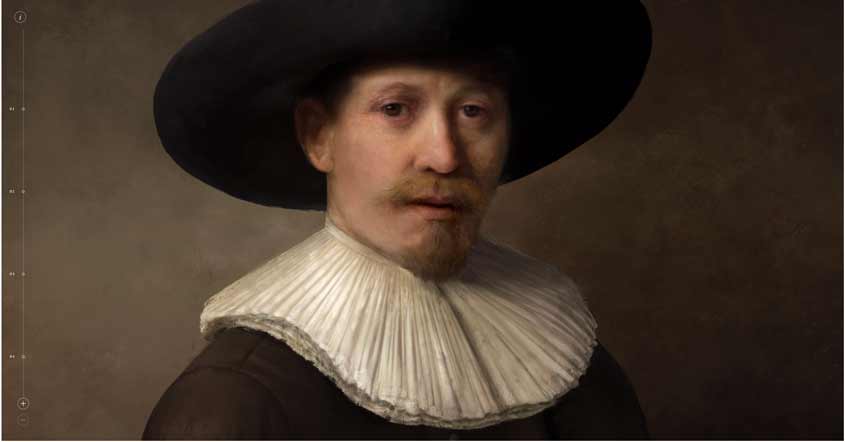
Google has just started funding an artificial intelligence program that volition write local news manufactures. In 2016, a group of museums and researchers in the netherlands unveiled a portrait entitled The Next Rembrandt, a new artwork generated by a estimator that had analyzed thousands of works past the 17th-century Dutch artist Rembrandt Harmenszoon van Rijn. A short novel written by a Japanese figurer program in 2016 reached the second round of a national literary prize. And the Google-endemic bogus intelligence company Deep Listen has created software that can generate music by listening to recordings.
Other projects accept seen computers write poems, edit photographs and even compose a musical.
Computers and the creative process
Robotic artists have been involved in various types of creative works for a long time. Since the 1970s computers have been producing crude works of art, and these efforts continue today. Nigh of these computer-generated works of art relied heavily on the creative input of the programmer; the machine was at most an instrument or a tool very much like a brush or canvas. But today, nosotros are in the throes of a technological revolution that may require united states of america to rethink the interaction between computers and the creative process. That revolution is underpinned by the rapid development of machine learning software, a subset of artificial intelligence that produces autonomous systems that are capable of learning without existence specifically programmed by a human being.
A computer program adult for machine learning purposes has a built-in algorithm that allows it to learn from data input, and to evolve and make future decisions that may be either directed or independent. When applied to fine art, music and literary works, machine learning algorithms are actually learning from input provided by programmers. They learn from these data to generate a new piece of work, making independent decisions throughout the process to make up one's mind what the new piece of work looks similar. An important feature for this type of artificial intelligence is that while programmers can gear up parameters, the work is really generated by the reckoner program itself – referred to as a neural network – in a process akin to the idea processes of humans.
Implications for copyright police force
Creating works using artificial intelligence could accept very important implications for copyright police force. Traditionally, the buying of copyright in computer-generated works was not in question considering the program was merely a tool that supported the creative process, very much similar a pen and newspaper. Artistic works qualify for copyright protection if they are original, with most definitions of originality requiring a human being author. Well-nigh jurisdictions, including Espana and Germany, state that only works created by a human can be protected by copyright.
But with the latest types of artificial intelligence, the computer plan is no longer a tool; it actually makes many of the decisions involved in the artistic procedure without homo intervention.
Commercial impact
One could fence that this distinction is not of import, but the manner in which the law tackles new types of car-driven creativity could have far-reaching commercial implications. Bogus intelligence is already being used to generate works in music, journalism and gaming. These works could in theory be accounted free of copyright because they are not created by a human writer. As such, they could be freely used and reused by anyone. That would exist very bad news for the companies selling the works. Imagine y'all invest millions in a organization that generates music for video games, simply to find that the music is non protected by law and tin can be used without payment by anyone in the world.
While it is difficult to ascertain the precise impact this would have on the artistic economy, it may well have a chilling result on investment in automated systems. If developers doubt whether creations generated through machine learning qualify for copyright protection, what is the incentive to invest in such systems? On the other hand, deploying bogus intelligence to handle time-consuming endeavors could still be justified, given the savings accrued in personnel costs, but it is too early on to tell.
Legal options
In that location are two ways in which copyright constabulary tin deal with works where human interaction is minimal or non-real. Information technology can either deny copyright protection for works that have been generated past a estimator or it tin attribute authorship of such works to the creator of the program.
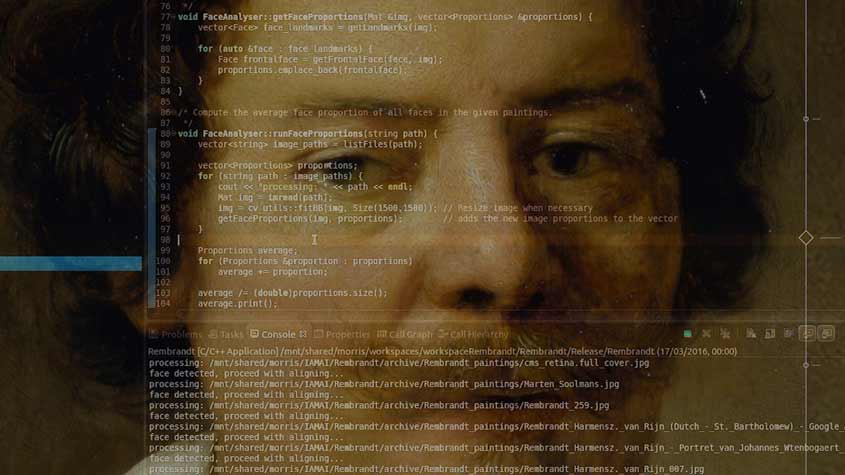
The Next Rembrandt is a reckoner-generated 3-D–printed painting developed by a facial-recognition algorithm that scanned data from 346 known paintings by the Dutch painter in a process lasting xviii months. The portrait consists of 148 million pixels and is based on 168,263 fragments from Rembrandt's works stored in a purpose-built database. The project was sponsored past the Dutch banking group ING, in collaboration with Microsoft, J.Walter Thompson marketing consultancy, and advisors from TU Delft, The Mauritshuis and the Rembrandt House Museum.
To my knowledge, conferring copyright in works generated by bogus intelligence has never been specifically prohibited. However, there are indications that the laws of many countries are not amenable to not-human copyright. In the United States, for example, the Copyright Function has alleged that information technology will "annals an original work of authorship, provided that the work was created by a human being." This stance flows from case law (e.1000. Feist Publications five Rural Phone Service Company, Inc. 499 U.S. 340 (1991)) which specifies that copyright police force only protects "the fruits of intellectual labor" that "are founded in the creative powers of the mind." Similarly, in a recent Australian case (Acohs Pty Ltd fiveUcorp Pty Ltd), a court declared that a piece of work generated with the intervention of a calculator could not be protected past copyright because it was not produced by a man.
In Europe the Court of Justice of the Eu (CJEU) has also declared on various occasions, particularly in its landmark Infopaq conclusion (C-5/08 Infopaq International A/Southward vDanske Dagbaldes Forening), that copyright only applies to original works, and that originality must reverberate the "author'southward ain intellectual creation." This is usually understood as meaning that an original work must reflect the author's personality, which conspicuously means that a human author is necessary for a copyright work to exist.
The second selection, that of giving authorship to the developer, is evident in a few countries such every bit the Hong Kong (SAR), Bharat, Ireland, New Zealand and the UK. This approach is best encapsulated in Britain copyright law, section nine(3) of the Copyright, Designs and Patents Act (CDPA), which states:
"In the example of a literary, dramatic, musical or creative piece of work which is computer-generated, the author shall be taken to be the person by whom the arrangements necessary for the creation of the piece of work are undertaken."
Furthermore, section 178 of the CDPA defines a reckoner-generated piece of work as one that "is generated past reckoner in circumstances such that there is no human author of the work". The thought behind such a provision is to create an exception to all man authorship requirements by recognizing the work that goes into creating a program capable of generating works, even if the artistic spark is undertaken by the machine.
Addressing ambiguity
This leaves open the question of who the law would consider to be the person making the arrangements for the piece of work to be generated. Should the law recognize the contribution of the programmer or the user of that plan? In the counterpart world, this is like asking whether copyright should be conferred on the maker of a pen or the writer. Why, and then, could the existing ambivalence prove problematic in the digital world? Take the case of Microsoft Discussion. Microsoft adult the Word calculator program only clearly does not own every piece of work produced using that software. The copyright lies with the user, i.due east. the writer who used the program to create his or her work. But when it comes to artificial intelligence algorithms that are capable of generating a work, the user's contribution to the artistic procedure may simply be to press a push button so the machine tin do its thing. There are already several text-generating machine learning programs out there, and while this is an ongoing area of research, the results can exist astounding. Stanford PhD student Andrej Karpathy taught a neural network how to read text and etch sentences in the same style, and it came upwards with Wikipedia articles and lines of dialogue that resembled the language of Shakespeare.
Some case constabulary seems to indicate that this question could be solved on a case-past-case basis. In the English language case of Nova Productions vMazooma Games [2007] EWCA Civ 219, the Court of Appeal had to decide on the authorship of a computer game, and declared that a player'south input "is not artistic in nature and he has contributed no skill or labour of an artistic kind". And then considering user action instance by instance could be one possible solution to the problem.
The future
Things are likely to become even so more than complex equally utilize of artificial intelligence by artists becomes more than widespread, and equally the machines become better at producing creative works, further blurring the distinction between artwork that is made by a human and that made by a calculator.
Monumental advances in computing and the sheer amount of available computational ability may well make the distinction moot; when you lot give a automobile the capacity to learn styles from large datasets of content, information technology will become ever meliorate at mimicking humans. And given enough computing power, soon we may not exist able to distinguish between human being-generated and car-generated content. We are not yet at that stage, but if and when nosotros do get in that location, we will take to decide what type of protection, if whatever, nosotros should give to emergent works created by intelligent algorithms with little or no human being intervention. Although copyright laws have been moving away from originality standards that reward skill, labour and effort, perchance we can constitute an exception to that trend when it comes to the fruits of sophisticated artificial intelligence. The alternative seems reverse to the justifications for protecting creative works in the first identify.
Granting copyright to the person who made the performance of artificial intelligence possible seems to be the well-nigh sensible arroyo, with the Great britain's model looking the virtually efficient. Such an arroyo will ensure that companies proceed investing in the applied science, safe in the noesis that they will go a return on their investment.
The next big fence will be whether computers should exist given the status and rights of people, but that is a whole other story.
Source: https://www.wipo.int/wipo_magazine/en/2017/05/article_0003.html
0 Response to "Who Owns the Rights to Work Created on Deep Art?"
Post a Comment