Rekindling the Multicultural History of the American Art Associationã¢ââ by Jordan S Potash
Featured Fellow member: Jordan Potash, Editor in Chief, Fine art Therapy: Journal of the American Art Therapy Association
May 2, 2019 | Inquiry | #WeAreArtTherapists
The AATA is pleased to introduce Hashemite kingdom of jordan S. Potash, PhD, ATR-BC, REAT, LCPAT (MD) LCAT (MD), every bit the Editor in Chief of Fine art Therapy: Periodical of the American Fine art Therapy Association. The journal is a prestigious peer-reviewed scholarly publication which has an audience comprised of practitioners, educators, researchers, and students. Its mission is to inform the readership of research, recent innovations, and critical issues related to art therapy.
 Dr. Potash is a registered, board certified, and licensed art therapist, as well equally a registered expressive arts therapist. He is an Assistant Professor in the Art Therapy Graduate Program at The George Washington Academy in Washington, DC and Honorary Assistant Professor at the Centre on Behavioral Wellness and Section of Social Piece of work and Social Administration, University of Hong Kong. In almost 20 years as an fine art therapist, he has worked with clients of all ages in many settings including schools, clinics, and community fine art studios. He is primarily interested in the applications of fine art and fine art therapy in the service of community development and social change, with an accent on reducing stigma, confronting discrimination and promoting cross-cultural relationships. Dr. Potash has taught courses and workshops and presented conference and community lectures in the U.South., Hong Kong, Thailand, Southward Korea, China, and Israel. He has authored and co-authored numerous articles and volume chapters, and co-edited the text Art Therapy in Asia: To the Bone or Wrapped in Silk (Jessica Kingsley).
Dr. Potash has held numerous leadership roles and served on a variety of committees within the Clan. He currently chairs the DC Fine art Therapy Licensure Committee of the Potomac Art Therapy Association and is a former chair of the Multicultural Committee (2003-2005) and Ethics Committee (2013-2016). He additionally serves as a member of the Multicultural Committee (since 1998) and on the Conference Review Committee (since 2012). Dr. Potash also brings extensive journal experience – as author, reviewer, and editor – to his current position. He served as Interim Associate Editor for issue ii of volume 35 (Special Issue: Medical Art Therapy), on the Journal Review Board since 2015, and every bit Book Review Editor and Advertizement-hoc Reviewer from 2010 to 2014. He has as well served on the Editorial Review Board of the Periodical of Humanistic Psychology since 2017. For more data, to view podcasts of past lectures, or to view his portfolio, please visit www.jordanpotash.com.
Dr. Potash answered some questions about his vision for the Periodical and offers advice for authors.
What is your vision for the AATA Journal?
I want to build on the potent foundation of the past editors to continue bringing the journal to meet gimmicky needs. My vision has iii facets:
- highlighting art therapy's unique contributions to health past identifying mechanisms of change,
- bridging enquiry and practice so that frontline fine art therapists tin put manufactures into directly utilise, and
- broadening the author base to ensure that all are included in the large umbrella of our diverse profession.
We accomplish these goals past ensuring quality content. I likewise hope that we can see the Periodical as an evolving forum rather than a static repository. Incorporating author discussions on the MyAATA Community Forum could offer a way to hear from and learn from readers on how they are incorporating Journal publications into their work.
What is the Journal's function in advancing the profession?
The Journal is one of our few art therapy specific outlets for scholarly reporting and critique. It is where we can communicate who nosotros are on our own terms to forward best practices and to explain to others what fine art therapists do. Considering of that, the Journal has to exist open to all, but maintain a disquisitional mindset that can claiming ideas in the involvement of moving the profession forward.
In addition to the 50th Ceremony effect, you have already announced two special issues this year – "Art Therapy and Inability Studies" and "Client Vocalism and Choice Through Art Therapy". What inspired y'all to select these topics?
Both areas are recognized gaps in the professional literature. Disability studies asks united states of america to place physical, rhetorical, and biased obstacles that prevent full inclusion in society. It is a field that challenges prevailing notions of normal operation and optimal wellness, likewise as curing and healing. I take been a fan of Sandie Yi's publications on inability and of Cathy Moon'due south contributions. They will be an excellent team to bring this topic to us as invitee editors of this special event. Theresa Van Lith has long advocated for art therapists to work in concert with clients to describe art therapy from the recipient'south perspective. This is crucial for developing best practices and enquiry agendas, besides equally advocating for what is special about our field. Theresa has a well-documented record in this area and will be able to bring the client vocalism to the forefront as guest editor. By choosing these underrepresented areas, I promise we hear from new authors.
If yous could give one slice of advice to potential authors, what would information technology exist?
Everyone has a story almost art therapy. Besides many times people say to me "I don't have anything interesting to say?" or " I don't accept the time." To the showtime question, I say that our field needs both large ideas and how theories can be straight applied with diverse clients. We all have something to teach and to larn. The Journal is structured to have articles, cursory reports, and viewpoints to allow for this range. To the second question, that is a real struggle of being a frontline art therapist. Writing has to exist scheduled and information technology helps to identify a writing buddy who can read drafts, hold you accountable, and offer encouragement.
When starting a inquiry project, how do you arroyo the bare page? Is at that place any advice you give to your students that y'all can share with us?
Research is fundamentally an exercise in curiosity. We are all researchers looking to explicate the world. Any miracle is ripe for understanding. Researchers are wonderers who demand to select the all-time method for the given state of affairs. Some are best interpreted in stories, some in numbers, and others through art. They can be observed just once or repeatedly over fourth dimension. Authors should keep in mind that when it comes time to communicate what they found and how they found it, they should write from that perspective'due south frame of truth so their studies can be validated on its own terms.
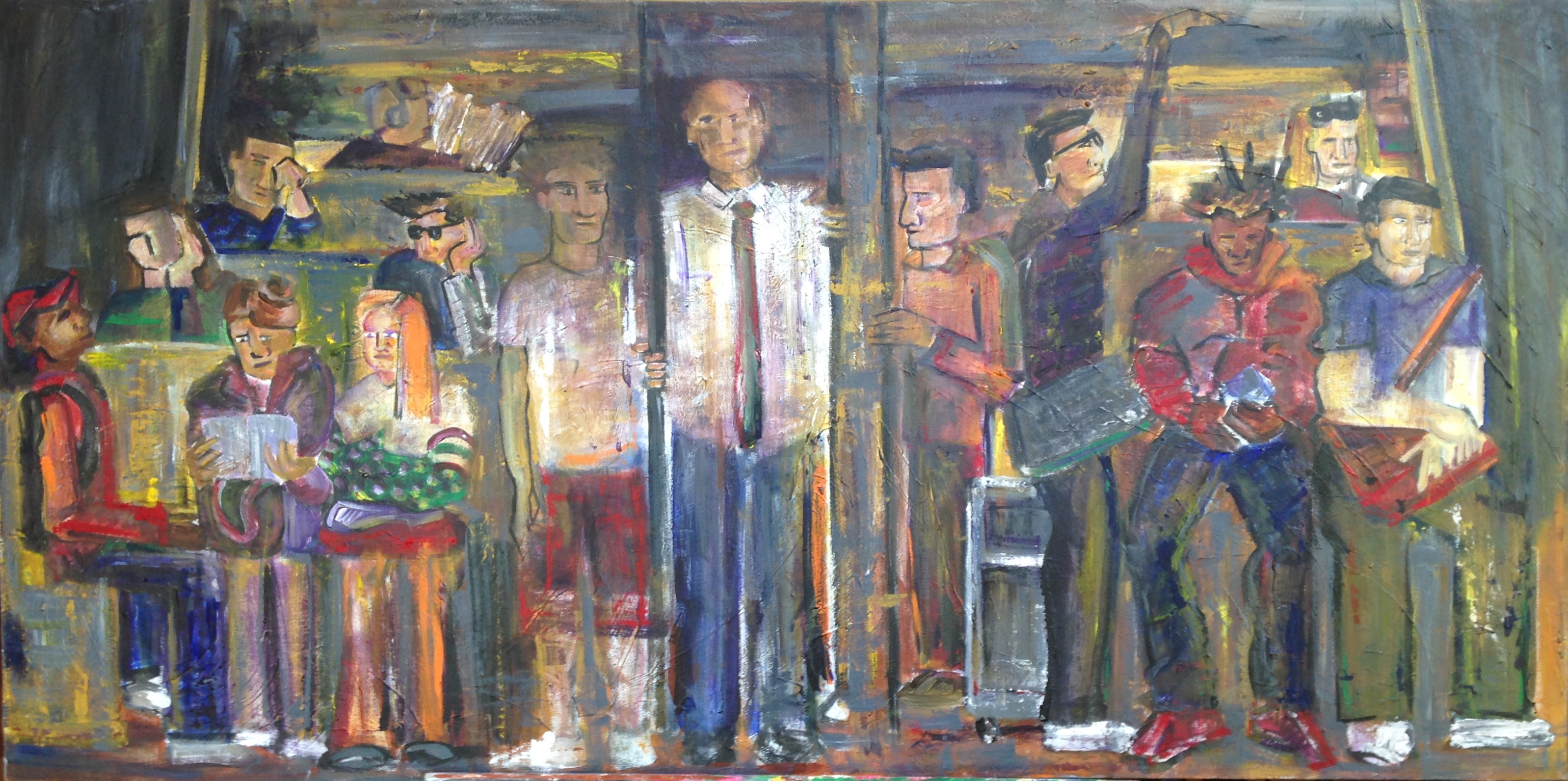
"Metro Riders" by Jordan Potash. 2018. Acrylic on canvas.
Artist'due south statement: "I started sketching people in public places as a style to pass the time and liven upward an otherwise dull commute. What I institute was that I developed a remote sense of intimacy with each subject. Public transportation is an odd infinite in that we all share it, but endeavor our best to interact with others equally fiddling as possible. This scene comprises several sketches from my commute over months. I sketched some of the individuals for almost a full commute, while others were only on the railroad train for a few stops. Even though I do not know annihilation about whatsoever of these people, as I reviewed my sketches and translated them to the canvas, I felt as if I was painting the portraits of long forgotten friends."
Dorsum TO NEWS
Source: https://arttherapy.org/blog-jordan-potash-journal-editor/
0 Response to "Rekindling the Multicultural History of the American Art Associationã¢ââ by Jordan S Potash"
Post a Comment