Virgin of Humility Fra Angelico Google Arts Culture Google Nd Web 08 June 2017
SONGS:
>> "Jesus Is Alive" by Ron Kenoly, performed in Japanese past Ruah Worship: Ruah Worship is a vocal ensemble made upwards of iv siblings from Nihon: (from left to right in video) Joshua Mine, Julia Mine, Erika Grace Izawa (née Mine), and Marian Mine. Here they sing an a cappella organisation of a Ron Kenoly song, translated into Japanese by Hiromi Yamamoto and Kazuo Sano. Click on the "CC" (airtight captioning) button for English subtitles. [HT: Global Christian Worship]
Their harmonies are wonderful! And they have lots of smashing videos on their YouTube channel, a mix of original songs and songs translated from other languages or written in Japanese. For another Easter-themed song they've recorded, see "Considering He Lives."
>> "I Went to the Garden" by Sam Hargreaves: Written in a bluegrass manner from Mary Magdalene's perspective, this vocal was released this year as function of the Resurrection People resource from the U.k. organisation Appoint Worship, where you tin can find downloadable videos (songs, webinars), canvass music, and church building service outlines that include prayers, all-age ideas, readings, poems, sermon outlines, responses, and more. Sam Hargreaves is on lead vocals and acoustic guitar, Timo Scharnowski is on backing vocals and percussion, and David Hyde is on banjo and slide guitar.
Some other song from the Resurrection People pack—one that made me laugh!—is "Peter's Slowcoach Blues."
+++
ART COMMENTARY: The Sherborne Missal: On this episode of the BBC Radio 4 program Moving Pictures, host Cathy Fitzgerald talks with art historians Alixe Bovey, Kathleen Doyle, Eleanor Jackson, and Paul Binski and scribe and illuminator Patricia Lovett about a page from the medieval illuminated Sherborne Missal that introduces the Mass for Easter Sunday. Made for the Benedictine abbey of St. Mary'due south in Sherborne, Dorset, around 1400, this Christian service book amazingly survived the pillaging of the English language Reformation intact.

At the summit is the historiated initial "R" for Ressurexit, with Christ emerging from his tomb. An elaborate edge effectually the folio contains scenes from the Sometime Attestation, portraits of prophets, a bestiary-inspired scene, angels, birds, plants, fantastical knights, and two wodewoses (wild men) engaging in a bizarre confrontation. Such imagination! Learn why a daddy lion breathing on his cubs signified resurrection to the medieval listen, and in what sense Samson and Jonah are "types" of Christ.
"The thing to grasp near medieval art," Binski says, "is that they don't accept the same categories and boundaries that we do. Nosotros have quite divers boundaries effectually what's comic and what'due south tragic, and what's serious and what's lightweight. In the Center Ages, serious things and playful things accompanied ane another; they were all role of the same thing."
+++
Call FOR ENTRIES: Chaiya Art Awards 2022/23: Submissions are now open—United kingdom of great britain and northern ireland residents simply—for this biannual competition on spiritually inflected visual fine art, this fourth dimension on the theme of "Awe and Wonder." In improver to the usual exhibition space for the longlisted finalists at London's gallery@oxo, Chaiya has secured a second venue, the Bargehouse, which will allow for larger-scale artworks and installations. The acme prize is ₤10,000. Deadline: August 31, 2022 .
+++
CIVA TRAVELING EXHIBITION: Heads, Faces, and Spiritual Encounter: Drawn from the collection of Edward and Diane Knippers and available for rental, this exhibition comprises 40-some artworks that all focus on the man face up. In that location are works by modern heavyweights similar Henri Matisse, Marc Chagall, David Alfaro Siqueiros, Georges Rouault, and Eric Gill, along with a few seventeenth-century portraits, African masks, and works past gimmicky artists of religion. I saw the exhibition in Austin, Texas, in November and was actually moved. Click on the link to scan the art and to enquire about rental.

VISUAL MEDITATION: "Golgotha, Auschwitz, and the Problem of Evil" by Victoria Emily Jones: Last month for ArtWay I was asked to write about Emma Elliott's Reconciliation, a sculpted marble arm that bears both a nail wound of Christ from his crucifixion and the number tattoo of Holocaust survivor Eliezer Goldwyn (1922–2017).

+++
ESSAY: "The church'southward reception of Jewish crucifixion imagery after the Holocaust" by Andrew Williams, AGON 48 (Winter 2015): Can Jews create Christian art? "I seek to revisit this question by examining the ways in which Jewish artists have made reference to the central symbol of the Christian organized religion, the crucifixion, and consider the ethical and theological horizons they open upwardly for the church. . . . Given its place as a symbol of oppression within Judaism, and in item its integration with the swastika during the years of Nazi power, its widespread adoption within a Jewish artistic vocabulary is remarkable." Williams discusses "how the resulting christological imagery has been freighted with meaning connected with collective suffering, personal grief and divine abandonment."

Jacob Epstein, Marc Chagall, Emmanuel Levy, RB Kitaj, Mauricio Lassansky, Abraham Rattner, Samuel Bak, Marking Rothko, Barnett Newman, Adi Nes, and Seymour Lipton are among the artists engaged in this illustrated essay. The writer provides an extensive bibliography if y'all'd similar to learn more than. I as well want to remind you of the excellent exhibition catalog essay "Behold the Man: Jesus in Israeli Art" that I shared back in 2017.
+++
UPCOMING VIRTUAL Outcome: Studio Talk with Indonesian Artist Wisnu Sasongko , April 28, 2022, eight:xxx a.yard. ET: Organized past the Overseas Ministries Study Centre at Princeton Theological Seminary, where Sasongko [previously] served as artist in residence in 2004–5. Cost: $15. Read the artist's bio and run across a sampling of his work at https://omsc.ptsem.edu/artist-sasongko/. At that place'southward also a catalog of his paintings you lot can purchase.

+++
ESSAY: "The Christian Art Scene in Yogyakarta" by Volker Küster: Published June 27, 2012, by Protestantse Theologische Universiteit (Protestant Theological University) in Kampen, Netherlands, this essay spotlights five Indonesian artists whose work culturally contextualizes the Christian story: Bagong Kussudiardja [previously], Hendarto, Hari Santosa, Dopo Yeihan, and Wisnu Sasongko. Küster provides biographical information on the artists, including their religious backgrounds (most are converts from Islam), and discusses three paintings by each, all of which are reproduced in full color.
Want to read more than by Volker Küster? His chapter on "Visual Arts in World Christianity" in The Wiley Blackwell Companion to Globe Christianity is excellent, and some of it is available in the Google Books preview. See likewise his book The Many Faces of Jesus Christ: Intercultural Christology (Orbis, 2001).
+++
Fine art VIDEO: "Caravaggio's Taking of Christ" (Great Art Explained): In 2020 art author and gallerist James Payne launched the YouTube video series Groovy Art Explained, consisting of xv-minute videos that each explore a single historically significant artwork. Here's one he did on an extraordinary painting of Caravaggio's from the collection of the National Gallery of Republic of ireland, which shows Judas's betrayal of Christ in Gethsemane.
LECTURE: "Georges Rouault and the Art of Sacred Engagement" by Fr. Terrence Dempsey, SJ: "From his earliest works, Georges Rouault [1871–1958] selected subjects that combined a potent religious conviction together with a concern for suffering humanity. This lecture by MOCRA Managing director Terrence Dempsey, S.J., offers an overview of Rouault's work, including his paintings, prints, and stained drinking glass. Dempsey presents Rouault as an artist who, from his early work through his mature work, remained concerned about the disadvantaged, the outsiders, and the victims of war, and who linked all of these people to the suffering of Christ. In this way, Rouault'south date with the earth was not so much political (although one can find political tones in his piece of work) every bit information technology was sacred. It involved the totality of who nosotros are—corporeal and spiritual."
Rouault is a favorite artist of mine. I got to come across his entire Miserere et Guerre ("Have mercy," a quotation from Psalm 51, and "War") serial of etchings in person a few years agone, and it's astounding. Every Christian needs to know this series. I recommend a copy of This Anguished World of Shadows: George Rouault's Miserere et Guerre for all bookshelves.
+++
ART VIDEO: "The Story Most the Painting Called The Exultant Leper": Wilder Adkins shared this video with me of his uncle Les Smith interpreting a painting he owns earlier his congregation last summertime at Trinity Episcopal Church in Martinsburg, Westward Virginia. He deputed it from creative person Brian Whelan, to depict the story of Jesus healing the ten lepers from Luke 17:11–19. Sadly, Smith passed away last month.
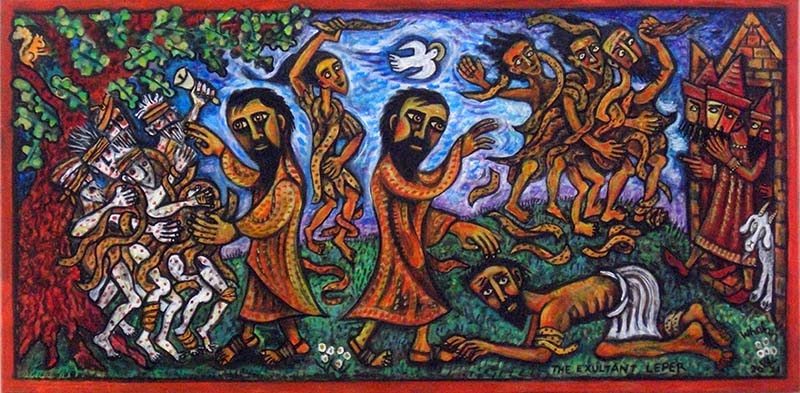
Smith said he requested the title "The Exultant Leper" and asked that it announced on the painting itself. "I am the exultant leper," he says, pointing to the figure at the bottom right. "I am the guy who better always be at the feet of Jesus giving cheers."
While I have certainly seen and shared plenty of academic presentations on fine art (such equally the one on Rouault above), in that location is something so special well-nigh hearing ordinary folks (that is, nonspecialists) share with others art that is personally meaningful to them—and more than than that, in this case, that they helped bring to fruition. Smith's enthusiasm was such that fifty-fifty his neighborhood trash collectors have been invited into his home to relish the piece! I dearest that he took the step of supporting a living artist past commissioning an original artwork, and that he integrated that art into his home life, displaying information technology above his mantle, where he would see it daily and exist reminded of his own story of transformation through Christ.
(P.S. Terminal autumn on Instagram and Facebook I shared a standout painting of Whelan's from the 8th Catholic Arts Biennial at the Verostko Centre for the Arts at Saint Vincent's College in Latrobe, Pennsylvania: https://www.instagram.com/p/CVS6tlagy8s/; https://www.facebook.com/artandtheology/posts/1582166995476777.)
+++
CROSS-DISCIPLINARY VIDEO PRESENTATION: "Psalms in Dialogue: (Be)Holding the Broken Pieces" : I shared Knuckles's first "Psalms in Dialogue" in October 2020. Here's their second offering in the same vein. "In this online presentation [which premiered October 2, 2021], Duke University Chapel and the Duke Chapel Choir will welcome visual artist Makoto Fujimura, theologian Dr. Ellen Davis, Tap Legacy Foundation co-founder Andrew Nemr, Ekklesia Contemporary Ballet, and dancer Paiter van Yperen for an evening of creativity and chat inspired by the biblical Psalms. In the program, artists, musicians, theologians, singers, and dancers will present performances and works inspired by five Psalms: 46, 88, 90, 91, and 92." I particularly enjoyed the teen ballet number choreographed by Elisa Schroth to Karl Jenkins'south "Healing Calorie-free: A Celtic Prayer" at 52:18 (lyrics below).
Deep peace of the running wave to you
Deep peace of the flowing air to you lot
Deep peace of the quiet earth to yousAmen
Deep peace of the shining stars to you
Deep peace of the gentle night to you
Moon and stars pour their healing lite on youAmen
Deep peace of Christ, the light of the world, to yous
Deep peace of Christ to you
Deep peace of Christ, the light of the earth, to youAmen
+++
SONGS:
>> "Fill up My Cup" by Thad Cockrell, feat. The New Respects: This song appears on Cockrell's anthology If in Instance You Feel the Same (2020); an older version is on Alone Together (2016) under the championship "Walking to a Urban center."
>> "Victory of Christ" by Cory Dauber: Cory Dauber is a member of the Deeper Well Gospel Commonage, a group of musicians and songwriters in the Portland, Oregon, surface area who are connected to Door of Hope church. Terminal year Dauber released his 2d full-length album, May All Times Go to You lot. This vocal appears on his debut album, Plow into a Mountain (2016).
Sundays are non counted toward the xl days of Lent (as they are banquet days, non fast days), and so I'm taking a break from my usual Lenten format today and for the next four Sundays to offering some supplemental content, such as a roundup of video, article, podcast, and event links, or a poem. Tomorrow I'll resume with "Mean solar day 5" of the music-art pairings.
+++
Trip the light fantastic VIDEO: "Lord, Forgive Me," choreographed past Keone Madrid: A short dance number to a penitential vocal by hip-hop/R&B creative person Republic of mali Music, choreographed by Keone Madrid. The dancers embody stumbling, floundering, aching, weakness, shame, and pleading, besides equally openness, humility, surrender, and peace—diverse postures/feelings associated with the act of confession. Starting at 42 seconds in, a succession of individuals stand up or kneel in relative stillness at the correct side of the frame, as if receiving the forgiveness they seek, while their dancing class is visible in the mirror.
Keone, the human in the maroon shirt in the opening shot of the video, is one-half of the choreo, dancing, and directing duo Keone and Mari [previously], whose other recent work includes choreographing the adorable (!) 2021 Disney blithe brusque The states Again (see trailer). Storytelling is at the root of their piece of work, with themes including marriage, family, faith, and struggle.
+++
NEW SONG: "No More Hiding" by Ben Thomas: For the past few years singer-songwriter and spiritual teacher Ben Thomas has been writing what he calls "Mantrasongs," songs "infused with intention" that are meant to get stuck in our head and connect us more fully to ourselves, others, and the Divine. Inspired by Fr. Richard Rohr's book Breathing Under Water: Spirituality and the Twelve Steps, this Jan Thomas started releasing a series of Mantrasongs on YouTube based on the Twelve Steps of Recovery, a tool developed in 1938 for Alcoholics Anonymous. "The 12 Steps of Recovery aren't just for those addicted to substances," Thomas writes. "They're for all of u.s.a. learning how to create lives of wellness and wholeness, gratuitous of the addictive patterns of thinking, seeing, and being that go on the states living at a fraction of our capacity."
"No More Hiding" is the fifth song in Thomas's Twelve Steps serial. Information technology corresponds to step 5 of the twelve-footstep program: "Admit to God, to yourself, and to another man being the exact nature of your wrongs." Christians would telephone call this process "confessing our sins." It can be a scary thing to do. It requires tremendous vulnerability and honesty. Only oh, what liberty comes from confession! He sings here with Jenny Miller. The preceding songs in the series are:
- "A New Level of Permit Become" (Admit that you are powerless over your addiction—that your life has become unmanageable.)
- "Make Me Whole Again" (Believe that a Ability greater than yourself tin can restore you to sanity.)
- "To Know What Is" (Make a conclusion to turn your volition and your life over to the care of God.)
- "Freedom in the Lite" (Make a searching and fearless moral inventory of yourself.)
Look out for a new Mantrasong each week. Y'all tin receive free song downloads from Ben Thomas by condign a Patreon supporter.
+++
VIRTUAL Issue: "Writing on Music, Meaning, and the Ineffable," March 24, 2022, 6 p.g. ET: It's been said that writing about music (or visual art, for that thing) is as pointless and incommunicable as dancing near architecture. Music and art demand only be experienced; studied assay or caption lessens their touch and is reductive. While I can see the reasoning backside this exclamation, and I often debate whether to comment on specific pieces that I mail here versus let the art exercise its work without my intervention, I do (obviously!) feel that there is value in writing about the arts, and music author Joel Heng Hartse does too. In this virtual launch event for his new volume Dancing most Architecture Is a Reasonable Thing to Practice, Hartse will exist joined in chat with poet Mischa Willett and musician John Van Deusen about fine art, faith, and criticism. Organized by Image journal.
+++
POETRY UNBOUND PODCAST EPISODES:
Poet and theologian Pádraig Ó Tuama hosts these wonderful fifteen-infinitesimal immersive readings of gimmicky poems selected from diverse sources. Here are 2 from last season that I particularly appreciated.
>> "How Prayer Works" past Kaveh Akbar: Kaveh Akbar is an Iranian American Muslim poet and scholar. In this narrative prose poem of his, ii brothers, seven years apart, plow to face east in their small shared room when their prayer is interrupted past a surprising noise, setting off an eruption of laughter. "This verse form holds the thought of prayer, which tin can often be an abstract one, with the physical sensation of what's correct in front of you, what'due south happening, who'southward right in forepart of yous, how are you being with each other, what'south going on, how tin you be drawn towards each other—and that that itself is the respond to prayer."
>> "The Only Cab Service of Farmington, Maine" past Aria Abner: "This is a verse form, really, that's an exploration of identify and all of the emotion and hurting and beauty that can be gathered into retention of place," Ó Tuama says. "A poem about chat and almost how you reach the edge of conversation." Poet Aria Abner was built-in in Federal republic of germany to Afghan parents but has lived in the The states since historic period eighteen. She writes about being picked up in a cab by a man who served in Afghanistan in the US Marines, and how he tries to connect with her through that geographic commonality but to piddling avail. "She is feeling estranged by the ways foreigners are speaking about a place that she'due south from but hasn't been able to grow up in."
For the first time, this year I programme on publishing short daily posts for the entirety of Lent and for the Octave of Easter, pairing a visual artwork with a slice of music along the seasons' themes (for an example of this format, come across hither)—merely an FYI of what to expect. I besides accept several poems lined upwardly. And y'all might want to check out the Fine art & Theology Lent Playlist and Holy Week Playlist on Spotify (introduced here and hither respectively), which I've expanded since last twelvemonth. I'm very pleased with the Holy Week Playlist in particular.
+++
NEW RESOURCE FOR HOME LITURGIES: The Soil and The Seed Projection: Directed by Seth Thomas Crissman of The Walking Roots Band [previously] and with the contributions of a squad of artists, writers, and musicians, "The Soil and The Seed Project nurtures religion through music, art, and Lilliputian Liturgies for daily and weekly use in the abode. These resources help establish new rhythms of faith every bit together we plow towards Jesus, assertive and celebrating the Good News of God's Love for the whole globe." The project launched in November 2021 with its Advent/Christmas/Epiphany drove. When the project is complete information technology will consist of four volumes of music (forty-plus songs total—all original, relieve for a couple of reimagined hymns) and four liturgical booklets that include responsive scripture-based readings, reflection prompts, suggested practices, and an original artwork.
The Lent/Easter/Pentecost collection releases Feb 25, merely equally a special treat, Crissman is allowing Art & Theology readers a "first listen" with this private link (it will turn public on Fri). Here's one of the songs, "I Want to Know Christ," a setting of Philippians iii:10–11 by Harrisonburg, Virginia–based songwriter and jail clergyman Jason Wagner, followed by a Picayune Liturgies sample:

Thanks to a community of generous donors, The Soil and The Seed Project gives away all its content for free, including shipping, to anyone who is interested (individuals, couples, families, churches, etc.); request a copy of the latest music collection and liturgies here. CDs and printed booklets are available simply while supplies final (1500 copies have been pressed/printed for this drove), but digital copies of form remain bachelor without limit.
+++
CONVERSATIONS AT CALVIN: Beneath are ii videos (of many!) from the 2022 Calvin Symposium on Worship, which took identify earlier this calendar month.
>> "Modern-Day Prophets: How Artists and Activists Expand Public Worship" with Nikki Toyama-Szeto: A writer, speaker, and activist on bug of justice, leadership, race, and gender, Nikki Toyama-Szeto is the executive director of Christians for Social Action and a leading voice for Missio Brotherhood. Here she is interviewed by preacher and professor Noel Snyder. They discuss the generativity of imagination, and its invitation to displacement; the connectedness between corporate worship and public witness; the motility of the Holy Spirit outside church walls; "political" and "pastoral" equally classifications that differ from grouping to group; embracing messiness; and what pastors can learn from artists and activists.
A few quotes from Toyama-Szeto that stood out to me:
- "Part of what nosotros're trying to practise at Christians for Social Action is stir the Christian imagination for what a fuller followership of Jesus looks similar in a more but club. The give-and-take 'imagination,' and I would say specifically Christian imagination, I think of as the dream that God dreams for his people and his creation. What does it hateful to be oriented toward the dream that God is dreaming? Another word for it is shalom—the total flourishing of all his cosmos and all his people. And if you look at the gap betwixt where we are today and what that dream is, that gap is imagination. How is it that we get from here, the broken world we see . . . how practise we press in and lean into the dreams that God dreams for his people and for his globe?"
- "For me, I accept found artists and prophets—those who are agitating for justice—are ones who help dislodge me from everyday things I take for granted, and those assumptions, and they assist me to dream new and bigger dreams."
- "The pursuit of justice is the declaration of God'south graphic symbol in the public foursquare."
Here are links to a few of the names and books she references: Sadao Watanabe, A Volume of Uncommon Prayer, Andre Henry [previously], The Many.
>> "Christians and Cultural Divergence," with Pennylyn Dykstra-Pruim and David I. Smith: María Cornou interviews Calvin Academy professors Pennylyn Dykstra-Pruim and David I. Smith, authors of Christians and Cultural Deviation (2016).
Smith shares his frustration that ofttimes the only Christians who endeavor to learn other languages and develop cultural intelligence and appreciation are those who are preparing to exist missionaries in a foreign country, and they practise it just for the purpose of missional effectiveness.
If you accept ane piece of theology [i.east., evangelism] and try and brand that the chip that's about cultural difference, that puts distortions into the conversation. . . . You might desire to call up nigh mission, merely you lot might likewise want to recall about what it means to exist made in the epitome of God. Does that mean anybody's the aforementioned, or does it hateful everyone has responsibleness for shaping civilization and nosotros might all do it in different ways, and you have to brand space for that? Nosotros might need to think about the cross. We might need to think near God'southward embrace of u.s. and how we embrace each other. We might need to think about love of neighbor. We might demand to recall about the torso of Christ and the makeup of the early church. . . . You might have to visit a whole bunch of unlike theological places to get a composite picture rather than saying this is the doctrine that somehow solves cultural divergence for us.
I was too struck past Smith's give-and-take of how cultural departure can assistance us read the scriptures in a new way (meet 19:38ff.). He gives an example from In the Land of Blue Burqas, where Kate McCord, an American, describes her experience reading the Bible with Muslim women from Afghanistan, and especially how they taught her a very different interpretation of John iv, the story of Jesus's encounter with the Samaritan woman at the well. Wow.
+++
VISUAL COMMENTARY ON SCRIPTURE: The Transfiguration : In churches that follow the Revised Common Lectionary, this Sunday, the last Sunday in the Epiphany season, is Transfiguration Lord's day, giving us a vision with which to enter Lent. (Other traditions gloat Jesus's transfiguration on August 6.) In this video from the Visual Commentary on Scripture project, art historian Jennifer Sliwka and theologian Ben Quash hash out this New Attestation upshot through three visual artworks: a fifteenth-century icon by Theophanes the Greek, which shows the "uncreated calorie-free" revealed to Peter, James, and John on Mountain Tabor; a fresco past Fra Angelico from the wall of a friar's cell in Florence, where Jesus'south pose foreshadows his suffering on the cantankerous; and a gimmicky light installation by the seminary-educated American artist Dan Flavin, comprising fluorescent lite tubes in the shape of a mandorla. Brilliant!
+++
CIVA TRAVELING EXHIBITION: Again + Over again, curated by Ginger Henry Geyer with Asher Imtiaz: "A photography exhibition that invites recurring and fresh contemplation of the ordinary and boggling through the seasons of the Christian liturgical calendar," sponsored by Christians in the Visual Arts. The show will be on view at Second Presbyterian Church in Indianapolis from February 26 to March 26 and is bachelor for rental in North America after that. I saw it at St. David's Episcopal Church in Austin in November at the CIVA biennial and was impressed! It is accompanied by a beautifully designed catalog that pairs each photograph with a poem, several of which were written specifically for the exhibition and which respond direct to a given photo.

Ane of my favorite fine art selections is Mount Tabor, June 2017 by Michael Winters, the managing director of arts and civilization at Sojourn Church Midtown in Louisville, Kentucky. "Mount Tabor . . . is where the transfiguration of Christ is thought to have occurred," Winters writes. "I stood viewing that scene in 2017. It looked so normal. I'm not sure why I felt compelled to punch holes in this photograph, but I think information technology's considering I wanted to be able to run into through this 'normal' mural to the glory of the transfigured Christ—which is to say, I wanted to see reality."
Scan all the Over again + Over again photographs on the CIVA website. Longtime followers of the blog volition recognize some of the photos from Greg Halvorsen Schreck's Via Dolorosa series that I featured back in 2016.
LECTURE: "PRESENCE: Illuminating Black History, Faith, and Civilisation" by Steve A. Prince: Printmaker, sculptor, draftsman, and "fine art evangelist" Steve Prince is the director of engagement and distinguished creative person in residence at the Muscarelle Museum of Fine art at the College of William & Mary in Williamsburg, Virginia—and a personal friend of mine! In this lunchtime presentation organized concluding fall past Upper House, a center for Christian gathering and learning in Madison, Wisconsin, he discusses his body of piece of work, which is influenced past his New Orleans groundwork and is full of symbols and of figures from African American history. Bessie Mitchell and the Trenton 6, Mamie Till, the Lilliputian Rock Nine, Henrietta Lacks, the Greensboro Four, Amadou Diallo, John Coltrane, Harriet Jacobs, and Sarah Collins Rudolph are merely a few of the people he references. He discusses the role of the arts in lament, healing, renewal, and celebration, framing the whole talk in terms of the first and second lines of the New Orleans jazz funeral—metaphors, he says, of life on earth ("the dirge") and life in the hereafter.

+++
Near HARRIET POWERS:
Harriet Powers (1837–1910) was an African American quilter from Georgia who used traditional appliqué techniques to record Bible stories, local legends, and astronomical events. Her two extant quilts, referred to every bit the Bible Quilt and the Pictorial Quilt, are considered among the finest examples of nineteenth-century Southern quilting. They actually are extraordinary.


>> Sewing Stories: Harriet Powers' Journeying from Slave to Artist, written by Barbara Herkert and illustrated by Vanessa Brantley-Newton: I received this children'due south motion picture-book biography near Powers as a Christmas gift last twelvemonth, and I love it so much. I recommend it for people of all ages! For easy reference, a photo of each of Powers's quilts is reproduced on the front and back endpapers. Listen to a complete reading by Alicia McDaniel of Art for the Creative Soul in the video below.
>> "Jubilant Harriet Powers and Quilt Stories," a chat at the MFA: Powers'due south 2 quilts were brought together for the first time ever in Fabric of a Nation: American Quilt Stories, an exhibition at Boston's Museum of Fine Arts that ran from October 10, 2021, to January 17, 2022. Curator Jennifer Swope moderated a virtual discussion about Harriet Powers and her legacy with creative person Bisa Butler; quilt historian, artist, and author Kyra East. Hicks; Dr. Carolyn L. Mazloomi, artist, educator, and founder of the Women of Color Quilters Network; and Dr. Tiya Miles, a public and academic historian.
A breakdown of the individual squares on Powers'south quilts happens at xiv:44–22:16, and conversation continues about Powers specifically until about the i-60 minutes marking. Notably, when asked nigh the importance of the quilts, Hicks says, "They're important considering you lot have a adult female who is testifying of her beloved for God 135 years after those quilts left her dwelling. She continues to bear witness. When y'all think virtually all the people . . . I but call back she'south a storyteller, but she's a storyteller with a purpose, and I adore her for that." The second hour is about story-quilting today—where a new generation of quilt-makers is taking the art course in the twenty-first century—and touches on functional use of quilts versus brandish.
For more than on Harriet Powers, see this v-minute video produced past the MFA, narrated by Dr. Miles.
+++
SONGS:
>> "Blessed Assurance": A Blackness gospel arrangement of a archetype Fanny Crosby hymn, performed by the Portsmouth Gospel Choir from the University of Portsmouth in the United kingdom.
>> "Parachute" by Arielle Howell and Moses Hooper: A song of surrender. Filmed in 2016, this was the showtime music video fabricated under the aegis of Under the Belltower, a Biola University initiative (no longer active) that brought together student musicians, composers, and filmmakers to make art in community and showcase that work with an end product.
Today'due south roundup brings together a theologian (Anderson Jeremiah), an art historian (Elissa Yukiko Weichbrodt), and a musician (Eric Lige and friends) who I think complement ane another really well!
SONGS:
Eric Lige [previously] is "a music-maker who promotes Jesus, Justice, Faith, and Community." He is the worship manager at Ethnos Community Church in San Diego and the co-executive producer of The Ethnos Project, which creates a platform for new and emerging global voices in musical worship to be heard worldwide. Peculiarly since COVID hit in 2019, he has been assembling multinational teams of musicians to produce YouTube videos, many of which are livestreamed equally part of Ethnos worship services. Hither are 3 examples (view more on Lige'south YouTube aqueduct):
>> "Ξεδιψασμένος (No Longer Thirsty)" by Kostas Nikolaou: A gimmicky Christian worship song in Greek, about how Christ, the living h2o, quenches our thirst for love and purpose. The lead singer is Nefeli Papanagi—and wow, do I honey her voice!
>> "Ua Mau (Hosanna)" past Moses W. Kaaneikawahaale Keale (aka Keale Ta Kaula): Reyn and Joy Nishii perform this nineteenth-century Hawaiian hymn past Keale "the Prophet," who converted to Christianity after calling on God during a hunting blow and finding rescue. The offset poetry translates to "Perpetual is the righteousness / That comes from the Father higher up / Let usa gather together / In his goodness and grace."
>> "Dearest's in Demand of Beloved Today" past Stevie Wonder: Edward Chen and friends—from Canada, the United States, Armenia, Venezuela, and United mexican states—perform the opening track from Stevie Wonder's Grammy-winning album Songs in the Key of Life. "God gave me this gift, and this particular song was a bulletin I was supposed to deliver," Wonder has said. "The concept I had in mind was that for love to exist effective, information technology has to be fed." Run into the full list of credits in the description on the video folio. Eric Lige is the one in the maroon shirt.
+++
LECTURES:
>> "Many Faces of Jesus: Christologies from the Margins" by the Revd. Canon Dr. Anderson H. M. Jeremiah, October 12, 2021: Anderson Jeremiah is a senior lecturer in the politics, philosophy, and religion department at Lancaster Academy in the Great britain, whose areas of expertise include Christian theology in Asia, postcolonial approaches to theology, Dalit studies, liberation theology, modern missionary movements, and inculturation and faith. Ordained in the Church of South India (part of the Anglican Communion), he was installed as Canon Theologian of Blackburn Cathedral in September 2021, making him the first Dalit to be appointed to that role in any English cathedral.
In this half-hour online talk given last fall for the Diocese of Manchester, Jeremiah discusses the Incarnation as a continuous event—Christ being born into man cultures—as expressed through a selection of visual artworks from Republic of ghana, Bolivia, China, Japan, and India. These images subvert the predominant Western image of Christ and sometimes provide critique. New to me was the black marble crucifix from the Anglican chapel inside Greatcoat Coast Castle, a former trading post (now a museum) where enslaved Africans were held before being loaded onto ships and sold in the Americas. I'm non sure who commissioned the sculpture or when it was placed at this site, just it definitely looks modern.
The Q&A that followed on the original Zoom consequence is not included in the video, but here's one of Jeremiah's comments from it that I transcribed: "Jesus is non strange to my own experience; this Jesus is part and package of my own existential reality. It [the epitome] enables people who are seeking peace and emancipation; [they are] emboldened in that process of seeing themselves reflected in the image of Jesus. The normative image the church has been belongings on to has not created that space." When one attendee asked if images of white Jesus are e'er "wrong" or to be discouraged, Jeremiah replied that there'south nothing wrong with such an image in itself, but the problem is when information technology is imposed on the entire world as the only style of looking at Jesus. "When we hold up 1 image every bit normative, we lose the diverse means God intends to manifest himself in diverse contexts," he said. (I couldn't agree more!)
To hear more from the Rev. Dr. Anderson Jeremiah, see "Dalit Theology in the Context of World Christianity: Subversion and Transgression," another excellent online talk that he gave in June 2021 at the invitation of the Oxford Centre for Religion and Culture. And this Grace Podcast episode from Oct, where he briefly discusses the From Lament to Action report of the Church of England's Archbishops' Anti-Racism Taskforce (published April 22, 2021), the contextual nature of all theology (contra the view that white Euro-American theology is somehow universal, whereas theologies that come up from Africa, for instance, need to exist qualified), and cultural appreciation versus appropriation. "I'one thousand trying to capture the experiences of communities through the stories they tell about Jesus," Jeremiah says. Follow him on Twitter @TheOutsider40.
>> "The Loving Look: Or, How Art History Taught Me About the Deviation Between Structure and Direction When Looking at Images of Race and Gender" by Dr. Elissa Yukiko Weichbrodt, Oct 12, 2017: Fine art historian Elissa Yukiko Weichbrodt, a professor at Covenant College who researches representations of race and gender in art and visual culture from the nineteenth century to the nowadays, is one of my favorite people to follow on Instagram (@elissabrodt). I dear how she helps people understand and use the tools of the discipline of art history. She teaches u.s. how images work and how to interrogate them.
In this undergraduate lecture (starts at iv:06), Weichbrodt discusses how photography has been used to shape racial bias and even construct race, too as gender, focusing on a famous 1957 photograph of school desegregation in Little Rock, Arkansas. She shows how this single photo is office of a larger spider web of significant that gimmicky news photos too play into. Nosotros're e'er interpreting and categorizing images in relationship to things nosotros've already seen, Weichbrodt says, creating a mental archive—for case, a file for "blackness," a file for "womanhood." And "equally Christians called to recognize the dignity of God's image in all people, we have to practise actual work to acknowledge how our ain archives may have hampered or distorted our dearest for our neighbors." To expect more faithfully, nosotros need to expect more; we demand to build a broader archive.
For related content from Weichbrodt, run into her 2018 series of manufactures for The Witness BCC: "Representing Race: Why Exercise Images Matter?," "Representing Race: Lenses for Estimation," and "Restorative Looking." You tin besides view a longer and more contempo version of this lecture, "Looking Justly," given October 30, 2019, at Christ Community Church in Franklin, Tennessee, which includes a Q&A.
+++
NEW PLAYLIST: February 2021 (Art & Theology): Continuing my initiative to share good music from the Judeo-Christian tradition . . . here'south a new (nonthematic) playlist I put together, which includes a fifteenth-century Jewish hymn (with a gimmicky tune past Ugandan rabbi Gershom Sizomu), a country 1-hit wonder from the sixties (thanks to my dad, a regular '60s Gold listener, for introducing me to this ane!), a virtuoso guitar limerick past Bruce Cockburn inspired by Jesus'southward first phenomenon, an original gospel vocal past Freedom Singer Bernice Johnson Reagon, the opening theme song of an antebellum telly drama, and more.
Vocal: "Put out into the deep" by David Bednall (2008), performed past The Gesualdo Six (2020): A verbatim setting of Luke 5:1–11 (RSV), the calling of the disciples, which is the Revised Common Lectionary reading for Feb 6.
+++
ESSAYS:
>> "Ghosts in Los Angeles" by Arthur Aghajanian, Ekstasis: The author of this essay reflects on Andres Serrano'south Nomads (1990), a humanizing series of portrait photographs of men and women experiencing homelessness in New York City. "Serrano titled each photograph with its subject field's showtime name, suggesting a familiarity with those portrayed while retaining their anonymity. . . . The images mimic the visual style of way and advertising, while also referencing historical portraits of the wealthy and powerful. The work restores the visibility along with the dignity of its subjects. . . . His diverse group reflects the vulnerabilities nosotros all share, and the grace that sustains us in arduousness."

>> "The Crevice in the Rock: A Theology of Negative Spaces" by Daniel Drage, Paradigm: This Paradigm journal essay explores profound negative spaces in scripture—the first Sabbath, exile, the passage opened up by the parting of the Red Sea, empty wombs, tombs, nail wounds, the cleft of a rock, the space between the golden cherubim's wings above the mercy seat—bringing them into conversation with works by gimmicky British sculptors David Nash, Rachel Whiteread, and Andy Goldsworthy. Emptinesses that are full and presence via absence are primal ideas.

+++
Blithe Curt FILMS:
>> Migrants, dir. Hugo Caby, Antoine Dupriez, Aubin Kubiak, Lucas Lermytte, and Zoé Devise: The graduation project of 5 film students from the Pôle 3D school in France, this curt follows a mother polar bear and her cub who are displaced from their Arctic home. When their ice float runs aground a new habitat and they're forced to learn a new fashion of life, the native brown bears treat them with hostility. The filmmakers said the project was initially inspired past the story of the Aquarius, a watercraft filled with refugees that grabbed global headlines when it was refused entry at Italian ports in 2018. [HT: Colossal]
>> Tokri (The Basket) , dir. Suresh Eriyat: A begetter-daughter story fix in Mumbai, this stop-motion animated brusque from Studio Eeksaurus is about mistakes and forgiveness, and how meaningful a kind extended manus from a stranger can exist . . . or not. [HT: Jumbo]
"Elevator Up Your Eyes" (Advent 2021): Kezia Yard'Clelland's annual "Alternative Advent" video is here—a compilation of news photos from the twelvemonth, from diverse photojournalists, matched with promises/declarations from scripture and a song. (I've described this project in years past; see here.) Migrant caravans, refugee camps, hospitals overwhelmed with COVID patients, a protest confronting a military coup, wildfires, volcanic aftermath . . . the global suffering nosotros hear almost in headlines and statistics is fabricated personal in these intimate photographs of people who are experiencing it immediate. M'Clelland bears tender witness to this suffering, but she also takes care to include signs of promise. Alongside images of devastation and misery are images of love, joy, and fortitude. The overall tone is i of somberness but not despair. As I practise with each year'south "Alternative Advent," I spent an afternoon interceding with God for each person in the photos and for others enduring the same harrowing journeys or disasters. I realize how my privilege equally a white, middle-grade United states American insulates me from a lot of these realities, and I know that prayer must be accompanied by action.
Discover out more context for the photos and their sources on Instagram @alternative_advent.
+++
VIDEO ROUNDUP FROM FULLER STUDIO: The Arts for the Life of the Church building: In these 6, five-minute videos shot by Fuller Studio, artists and creatives (near of them participants in the Brehm Residency) reflect on the various ways that the arts enliven, shape, and define their faith, their theology, and their work. Here's one from the serial, in which interdisciplinary artist Dea Jenkins discusses the ways the Spirit's leading can exist intertwined with the procedure of fine art-making, and how art has the capacity to be both prophetic and healing.
The other videos feature . . .
- Young-Ly Hong Chandra on how she sees her creative piece of work participating in God's piece of work of creation
- Michelle Lang-Raymond on how theater and the arts tin can create opportunities for us to safely withal deeply engage with today's polarizing issues
- Rachel Morris on how incorporating the arts into worship services and pastoral intendance can contribute to the church'south healing work in the lives of its members
- Jin Cho on the holistic, social, and communal dimensions of preaching and the liturgy
- John Van Deusen on the significance of creating art in community and on the means we are shaped by inviting both God and others into our creative processes
+++
ON BEING INTERVIEWS:
>> "Remembering Desmond Tutu": The South African Anglican bishop, theologian, and human rights activist Desmond Tutu died December 26, 2021, and the On Beingness podcast re-released this 2010 interview Krista Tippett conducted with him. Information technology's a not bad introduction to his story, which includes especially his faith. He discusses the Bible every bit "dynamite," our identity every bit "God-carriers," the interfaith makeup of the anti-apartheid movement, God's humor, reconciliation equally a process, his experience voting for the first fourth dimension at historic period sixty-iii (later on decades of disenfranchisement), how entrenched racism had become in his own thinking, the beating center of dear at the center of existence, and more than. And oh, his laughter is so sugariness!
>> "A Life of Holy Curiosity: In Friendship with Rachel Held Evans" with Jeff Chu: Jeff Chu is a journalist, preacher, and co-leader of the Evolving Faith customs. When his friend Rachel Held Evans, the famous Christian author, died unexpectedly in 2019, he took it upon himself to bring to fruition the unfinished book she was working on, Wholehearted Faith (HarperOne, 2021). I enjoyed learning more than about Evans through this conversation, and about Chu. They read several excerpts from the volume and hash out Chu's Chinese Baptist upbringing, the recent phenomenon of "religious-simply-in-exile," the enormity of God's dear, the Incarnation, the Psalms, doubt, grief, and the lesson of the compost pile.
(Equally a side note: I recently came across Evans'southward other posthumously published volume, for children, titled What Is God Similar?, in Target and bought it on a whim. It'south fabulous.)
+++
SONG: "I Lift My Eyes" by Christopher Tin: A setting of Psalm 121 in Arabic, performed by Abeer Nehme with Christopher Tin and the Affections City Chorale. Nehme is a Lebanese vocaliser and musicologist, one of whose specializations is sacred music from the Syriac Maronite, Syriac Orthodox, and Byzantine traditions. [HT: Joy Clarkson]
Projection MAPPING INSTALLATION: Il Natale di Francesco (The Christmas of Francis): Final year the Sacro Convento in Assisi, a Franciscan friary, initiated an architectural lighting project called Il Natale di Francesco that featured projections of Christmas-themed frescoes past Giotto from the Lower Basilica of St. Francis onto several of the city's landmark churches. Architect Mario Cucinella served as artistic director, and the visitor Enel Ten realized the installation, which ran throughout Appearance and Christmastide, from December 8, 2020, to January vi, 2021 (and I hear information technology's been reprised this yr!). The pièce de résistance was the project of Giotto's Nativity onto the facade of the Upper Basilica of St. Francis. Other projections included the Annunciation on the Cathedral of San Rufino, the Visitation on the Basilica of Saint Clare, and the Adoration of the Magi on the abbey church of San Pietro in Valle—all images adapted using advanced engineering to suit the spaces they illuminated.


Other components of the installation included frescoed stars from the main basilica's vaults projected onto the streets; a re-creation of Giotto'southward scenes with dozens of sculpted figures, including the addition of a masked nurse at the crèche in laurels of all the frontline healthcare workers serving during the COVID-19 crisis; and every thirty minutes a video-mapping prove that offered views of the basilica's interior. I so dearest the inventiveness of bringing the sacred fine art treasures of the church out into the town squares when the pandemic necessitated church closures.
+++
VIRTUAL CONCERT: Christmas with the Sakhnini Brothers : The Sakhnini Brothers are Adeeb, Elia, and Yazeed, iii Arabic-speaking brothers from Nazareth who are followers of Jesus. They play about 20 instruments collectively but specialize in piano, oud, and violin, respectively, and beloved to blend modern Western and ancient Eye Eastern musical styles.
In this half-hour living room concert that premiered December 13, they are joined by vocaliser Nareen Farran, pianist Sireen Elias, and percussionist Firas Haddad. They perform an instrumental rendition of "God Remainder Ye Merry Gentlemen"; "Amano Morio" (With Us the Lord), a traditional hymn from the Syriac Maronite liturgy, whose lyrics translate to "The Lord is with us day and night"; "O Come, All Ye Faithful" in Arabic; "Sobhan Al Kalima" (Glory to the Word), some other traditional hymn in Syriac (see YouTube video description for full English translation); "Mary, Did You lot Know"; and "Laylet Eid" (Christmas Eve), a song past Fairuz to the melody of "Jingle Bells." Their arrangements are fantastic! (Y'all especially take to hear what they do with that closing number; I can't finish smiling.)
You can support the Sakhnini Brothers on Patreon and follow them on Facebook.
+++
PLAYLIST: Global Christmas Music YouTube Playlist : At the request of Inspiro Arts Brotherhood, my friend Paul Neeley, an ethnodoxologist blogging at Global Christian Worship, has curated a playlist of twenty-eight Christmas songs from effectually the world. Languages include French, Yoruba, English language, Arabic, Gaelic, Huron, Norwegian, Nepali, German, Hindi, Thai, Italian, Urdu, Spanish, Pangasinan (Philippines), Zulu, Korean, and Swahili. Here are just 2 videos from the listing: "The Greatest Gift," an original stone vocal by Sinn Patchai from Thailand, and "Don Oíche Úd i mBeithil" (That Night in Bethlehem), a traditional Irish carol performed by Mairéad Ní Mhaonaigh.
Neeley likewise put together a listening guide so that you tin can follow along with the lyrics.
+++
VIRTUAL EXHIBITION: Visual Music: Calligraphy and Sacred Texts , Henry Luce III Middle for the Arts & Religion: "'Course,' wrote Jewish-American artist Ben Shahn, 'is the very shape of content.' Shahn's argument serves as the guiding principle for this exhibit. Each of these xv pieces, all by living artists, is a calligraphic interpretation of a text sacred to Jews, Christians, or both. Each creative person has pondered their chosen text, explored information technology inside and outside, and provided their own rendition of information technology—their own 'translation' into visual form."
Jonathan Homrighausen, a doctoral student in Hebrew Bible at Duke University who writes and researches at the intersection of Hebrew Bible, calligraphic art, and scribal craft, has curated this wonderful online art exhibition for the Henry Luce Three Center for the Arts & Religion at Wesley Theological Seminary in Washington, DC. I spent hours viewing all the rich content on the website, including Homrighausen's illuminating commentaries (which take us beyond a simplistic "ooh, pretty" response), and following links to learn more. From the exhibition homepage you can click on any of the images for a detailed description, detail photos, embedded videos and music, and suggested articles for further reading.
Besides check out the video presentation Homrighausen gave on December 12 for the Jewish Art Salon in New York City in which he discusses five of the Hebrew Bible–based pieces on brandish, plus 2 that render rabbinic quotes. The Q&A that follows is moderated by Jewish calligrapher Judith Joseph.
Since many of my weblog readers volition have simply read Mary'south Magnificat from Luke 1 this by Sunday (information technology's one of the assigned lections for Advent 4) and nosotros're just a few days away from the feast of Christmas, allow me share these two timely images from the exhibition:


+++
VISUAL MEDITATION: "An Icon of Deep Incarnation" past John A. Kohan: Fine art collector John A. Kohan reflects on the painting Madonna of the Woods by Cypriot creative person Charalambos Epaminonda, a variation on the Virgin Hodegetria blazon. "God took on human flesh and entered creation not just to bring you and me personal salvation or rescue the human race from sin and decease, merely to restore and renew the entire world and all that is therein. Gimmicky theologians in our age of ecological sensation call this concept 'deep incarnation' . . ."

Source: https://artandtheology.org/tag/roundup/
0 Response to "Virgin of Humility Fra Angelico Google Arts Culture Google Nd Web 08 June 2017"
Post a Comment